

Around the world, rural families face the interwoven challenges of poverty, degraded land, and limited opportunity. Plant With Purpose partners with these communities to restore both the land and livelihoods, cultivating resilience that begins with the soil and extends to the soul.
At the heart of this mission lies a remarkable outcome: participants’ incomes rise by an average of 325%. But this increase is not just about money, it’s about transformation. It represents families who are reclaiming their God-given potential, stewarding creation wisely, and building a future of hope.

Regenerative Agriculture: Healing the Land and the Economy
Economic growth starts in the fields. Most participants in Plant With Purpose programs are smallholder farmers whose livelihoods depend on the health of their soil. Years of erosion, deforestation, and unsustainable practices have left many unable to produce enough to feed their families.
Through training in regenerative agriculture, farmers learn to restore the land using techniques like composting, mulching, crop diversification, and tree planting. These methods improve soil fertility, retain water, and increase yields. When the land flourishes, so do the people.
Farmers report higher harvests and a greater variety of crops, resulting in improved nutrition and new sources of income. They can now sell surplus produce, raise livestock, and benefit from tree-based crops such as fruit or timber. This agricultural renewal lays the foundation for long-term economic stability.

Economic Empowerment: The Power of Purpose Groups
Environmental restoration alone isn’t enough. Poverty also thrives in the absence of opportunity, financial resources, and supportive community structures. That’s where Purpose Groups come in.
Purpose Groups are community-based savings and loan associations formed within each partnering village. Members meet regularly to save money together, learn financial literacy, and access small loans. These groups become centers of collaboration and trust—empowering families to invest in farms, start small businesses, or cover school fees.
Statistically, Plant With Purpose participants are 167% more likely to be saving for the future than non-participants. They hold 2.3 times more savings in reserve and have 24% more diverse income sources. What begins as small savings soon grows into entrepreneurial momentum.
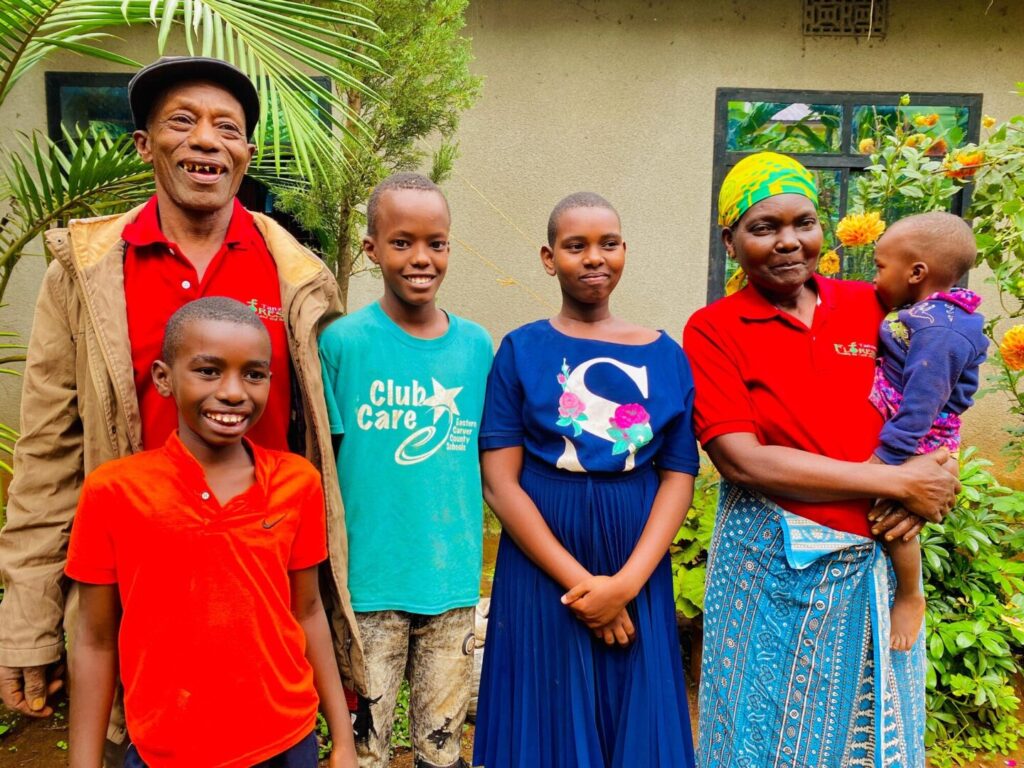
Savings mean security. When emergencies strike, like illness or drought, families no longer face ruin. When opportunity knocks, they have the means to respond. As Stanley in Haiti said, “In my group, we live as brothers and sisters. We save money together, share loans, and work in the field. These many changes give us pride and hope for the future.”
Spiritual Renewal: Hope as an Economic Engine
Plant With Purpose’s work is rooted in faith. Transformation is not merely material, but also spiritual. As farmers gather in Purpose Groups, they also gather around God’s Word. Bible studies and discipleship strengthen their sense of dignity, purpose, and hope.
This spiritual renewal translates directly into economic behavior. When people see themselves as stewards of creation and co-laborers with God, they make wiser choices about land, money, and community. Training emphasizes the dignity of farming, affirming that working the land is holy work.
Faith brings unity and trust within groups. It cultivates integrity in savings, fairness in lending, and generosity in community projects. As spiritual maturity deepens, people gain the resilience and direction needed to navigate uncertainty. The outcome is not only higher income, but also a renewed sense of calling and community.
Measuring Transformation: The Income Matrix Method
Traditional income surveys often fail to capture the complex realities of smallholder farming. Many families have multiple income sources, seasonal variability, and minimal record-keeping. Asking “How much do you earn?” directly can feel intrusive or inaccurate.
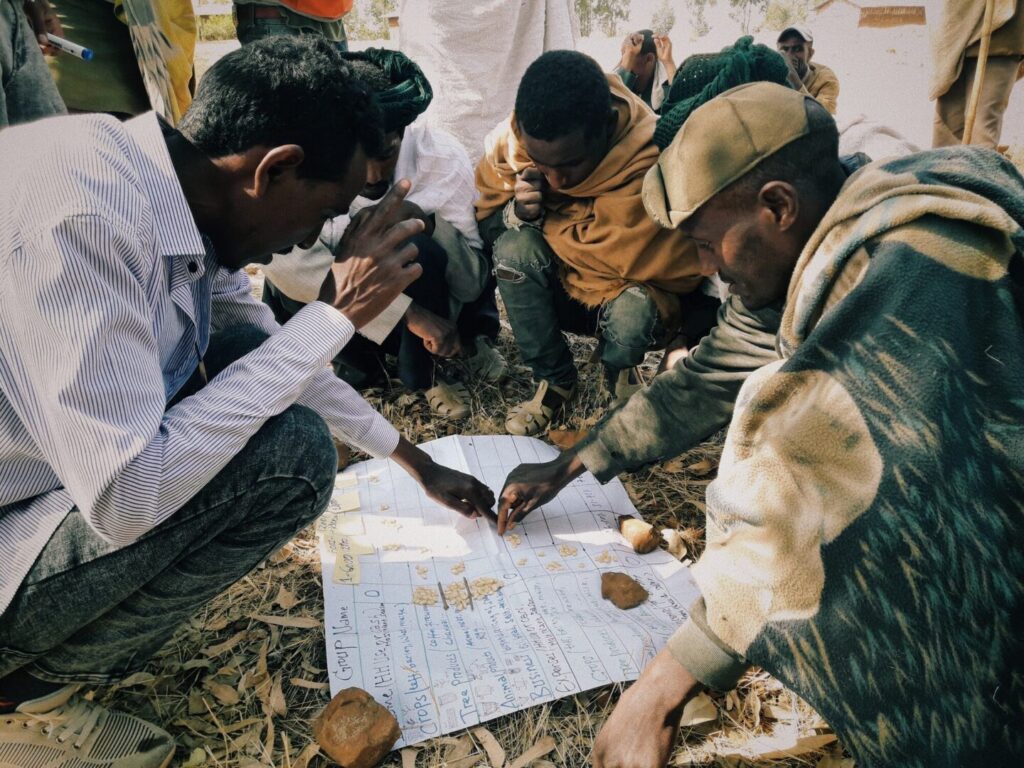
To address this, Plant With Purpose developed a participatory tool called the Income Matrix Workshop. It’s a community-based way to measure financial progress while honoring local rhythms and respect.
Here’s how it works:
- Discussion: Participants identify all income sources, such as crops, livestock, trees, and small businesses, and define a “good” harvest season.
- Set-Up: The facilitator lays out a poster grid divided into income ranges. Each farmer receives beans to represent income choices.
- Reporting: Farmers place beans on the matrix to indicate how much they earn from each source and the percentage each contributes to their total household income.
- Debrief: Participants discuss insights, patterns, and surprises together.
- Analysis: Staff photograph and digitize the results to calculate averages and track growth over time.
This simple yet powerful approach has been implemented in hundreds of Purpose Groups across five countries. It’s cost-effective, accurate, and respectful, providing statistically significant data that captures both the financial and relational aspects of transformation.

Stewardship and Justice
Plant With Purpose views income not as an end goal but as an indicator of holistic transformation. Increased earnings point to deeper realities: healthier ecosystems, stronger communities, and restored hope.
When a farmer’s income rises, it signifies:
- Improved soil health and restored land productivity.
- Economic resilience, where families can plan and invest rather than merely react.
- Education opportunities for children that break generational cycles of poverty.
- Home improvements and better living conditions.
- Community cooperation is people working together to address local challenges.
The ripple effects extend beyond individual households. As incomes stabilize, communities become more generous, local churches thrive, and neighbors unite around shared goals. It’s a living picture of what Jesus described as an abundant life, where every aspect of creation flourishes together.
At its core, this work reflects biblical principles of stewardship, justice, and love for neighbor. Farmers are not simply recipients of aid; they are co-laborers in God’s redemptive work. Plant With Purpose’s model is built on the belief that creation care and poverty alleviation are inseparable. Restoring the land and empowering people reflect God’s heart for wholeness.
As families learn to steward their resources and environment, they model what sustainable discipleship looks like. It’s not mere charity, but restoration. It’s the gospel in action, where spiritual renewal fuels environmental and economic revival.
Spiritual Renewal, Environmental Restoration, and Economic Empowerment work together. Each reinforces the other. Healthier soil leads to more productive harvests; stronger savings groups foster unity and generosity; spiritual growth strengthens perseverance. The result is “compound impact.”

This interconnected approach explains why participants’ incomes have increased by 325%. It’s not one intervention but the integration of many, woven together in faith and community.
Each family’s story is unique. Some launch small enterprises; others expand farms or plant tree nurseries. Some invest in their children’s education; others strengthen local churches. But all share a renewed sense of dignity—the conviction that they are not defined by poverty, but by purpose.
When incomes rise through Plant With Purpose’s programs, it’s more than an economic success story. It’s a story of flourishing—of people, land, and faith coming alive together.
The 325% increase is not merely a statistic. It reflects restored ecosystems, empowered families, and communities living in right relationship with God, one another, and creation.
As Scripture reminds us in Isaiah 58:12, “You will be called the repairer of broken walls, the restorer of streets to dwell in.” That is the vision Plant With Purpose lives out every day—cultivating communities of hope where prosperity grows from the ground up.


